If you're wondering how to track workouts, here's the short version: write down every working set (exercise, weight, reps) the moment you finish it, in a tool you'll actually open again next session. That log quietly becomes the most useful piece of equipment you own, because you can't beat last week's numbers if you don't know what they were.
This guide covers why tracking is the highest-return habit in the gym, exactly what to log (and what to skip), whether paper, a notes app or a dedicated workout tracker fits you best, and how to read your data once you have it.
Why tracking is the highest-ROI habit in the gym
Almost every result in the gym runs on progressive overload: doing slightly more than last time. The catch: your memory is a terrible training partner. Ask anyone what they benched for their third set eight days ago and you'll get an "uh, 60? maybe 55". Memory rounds up on good days, rounds down on bad ones, and forgets the details that actually matter.
A log turns a vague intention into a concrete target: last session was 60 kg for 8, so today you aim for 60 for 9. Without the log you're guessing; with it, every session starts with a goal. That's why tracking beats almost any program tweak, supplement or gadget: it costs zero extra effort in the gym and makes everything else measurable.
Leo's tip: log the set the second you rack the weight. "I'll write it down after" is how three precise sets become "roughly three-ish sets" by the drive home.
What to track (and what to ignore)
A good workout log is boring on purpose. Four things carry almost all of the signal:
- The exercise: precise enough to compare later. Incline dumbbell press and flat barbell bench are different lifts with different numbers.
- Weight and reps for every working set: the core of the log. This pair is what should progress over time.
- How it felt (optional): one word like "easy" or "grindy" makes next week's decision instant.
- Rest times (optional): worth logging if you tend to scroll for five minutes between sets without noticing.
What not to obsess over: calories burned per session (rough estimates at best), day-to-day bodyweight swings, or a mood score out of ten. Simple rule: if a number doesn't change what you'll do next session, it's decoration, not data.
Paper vs notes app vs dedicated tracker
The best tracking tool is the one with the least friction for you, because a log dies the day it starts feeling like homework. An honest comparison:
- Paper notebook: zero distractions, zero battery anxiety. But no search, no charts, and one washing machine away from losing a year of data.
- Notes app: free and always in your pocket, which is why most people start there. The problem shows around week six: a wall of unstructured text you'll never re-read, with no way to tell whether your squat is actually going up.
- Dedicated tracker: shows last session's numbers next to today's empty fields, adds up your volume and spots your records for you. Your log becomes data instead of a diary.
If a notes app is what keeps you consistent, keep it: an imperfect log beats no log every time. But the moment you want the best way to track gym progress rather than just record it, structure wins.
How to read your data
A log you never re-read is a diary, not a tool. Three signals cover most of what matters:
- Volume trend per exercise: sets × reps × weight, week after week. Slowly rising means you're building; flat for a month means it's time to change something.
- Personal records: a new best weight, or more reps at the same weight. Frequent when you start, rarer as you advance. Both are normal.
- Stalls: three or four sessions at identical numbers. That's not failure, it's information: check your sleep, your food and your recovery before you change the whole plan.
Keep the review light. Five minutes on a Sunday scanning trends is plenty: you're a lifter reading a log, not a data scientist building a dashboard.
Common tracking mistakes
Most tracking habits don't die from laziness, they die from one of these:
- Tracking everything: fifteen metrics per session guarantees you quit by week three. Weight and reps carry most of the signal.
- Never reviewing: data you don't look at can't change anything. Logging without reading is admin, not training.
- Changing exercises constantly: you can't compare sessions that have nothing in common. Keep your main lifts stable for at least six to eight weeks.
- Only logging the good days: bad sessions are data too. They're how you spot patterns like "every Monday after a short night is a rough one".
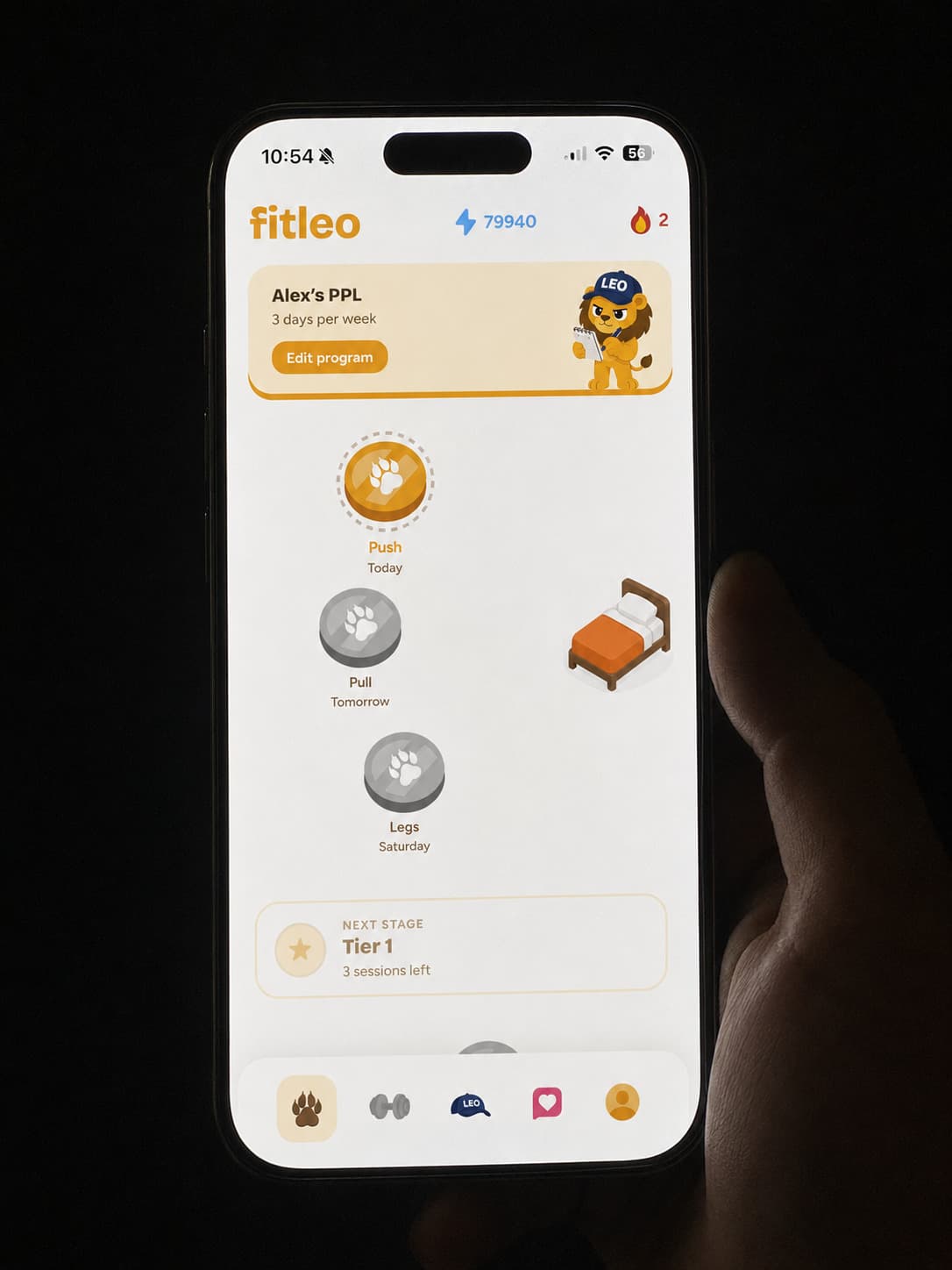
How to track your workouts with fitleo
In fitleo, workout logging is free and unlimited: no session caps, no "upgrade to keep your history". The tracker is the core of the app, not the paywall.
- Fast set logging: your last session's weight and reps are pre-filled, so confirming a set takes a tap, not a form.
- Automatic PR detection: beat a record and fitleo flags it on the spot, no digging through history required.
- Volume and strength charts per exercise: see at a glance whether your bench is trending up or has been flat for a month.
- Leo reads your sessions: after each workout, your coach analyzes what you did and tells you what it means and what to aim for next.
- Streaks and XP: showing up gets rewarded, which is exactly the habit tracking exists to build.
And once your log has a few weeks of data in it, Leo can generate a personalized program built on what your numbers actually say about you.
Quick questions
What's the best free app to track workouts?
Plenty of trackers are free to download but cap your sessions or lock your history behind a subscription. In fitleo, logging is free and unlimited: every set, every session, your full history. Leo's coaching and personalized programs are part of fitleo+, but the tracker itself never locks.
Should I track every single set?
Track every working set: that's the data your progression is built on. Warm-up sets can stay off the log unless you like having them. If tracking everything feels heavy, cut the optional extras before you cut the working sets: consistency matters more than completeness.
How do I know if I'm actually progressing?
Look at trends over weeks, not from one session to the next: more reps at the same weight, more weight for the same reps, rising volume per exercise, and the occasional personal record. Day-to-day fluctuation is normal noise: a bad Tuesday tells you almost nothing.
Is paper or an app better for tracking workouts?
Whichever one you'll actually use every session. Paper works great to start and never runs out of battery. An app pulls ahead the moment you want to search your history, see trends or detect records without doing the math yourself, and it's much harder to lose.
Keep reading
- Progress6 min read
Progressive Overload: The Complete Guide to Real Gains
What progressive overload really means, the levers ranked, how fast to progress, and how to break a plateau when the weights stop moving.
- Programs4 min read
Personalized Workout Plan App: Get a Plan Built for You
How a personalized workout plan app builds a training plan around your goal, schedule and equipment, and why it beats generic PDF programs.
- Progress5 min read
How Many Days a Week Should You Work Out?
How many days a week should you work out? For most people, 3–4 is the sweet spot. The honest answer by goal, plus full body vs split.
- Standards and data5 min read
How Many Calories Does Lifting Weights Burn?
How many calories does lifting weights burn? Honest estimates land around 200–500 per hour. The afterburn effect, lifting vs cardio, and what to track instead.