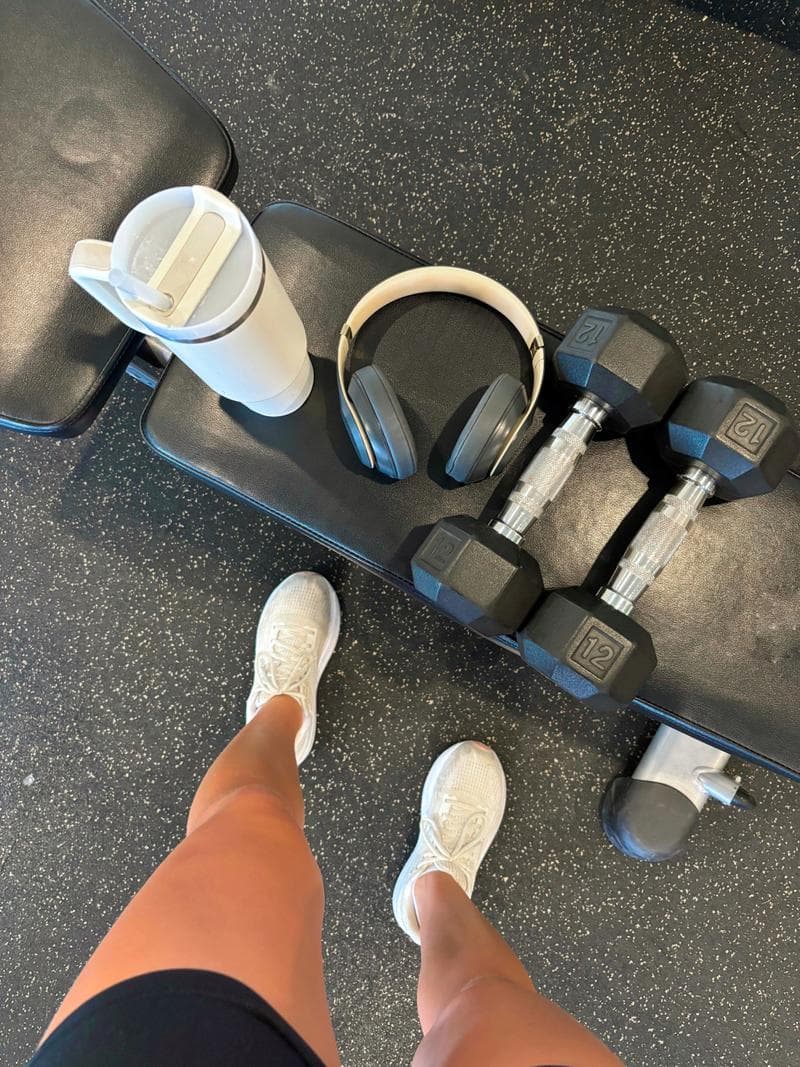
Progressive overload means doing measurably more over time (more reps, more weight, more sets) on the same movements. It's the single principle behind every muscle and strength gain: if your training doesn't gradually ask more of your body, your body has no reason to change.
This guide breaks down what overload actually looks like in practice: which levers to pull and in what order, why tracking is non-negotiable, how fast you should expect to progress, and what actually breaks a plateau when the bar stops moving.
What progressive overload actually means
Your body adapts to the stress you give it. Lift a weight that challenges you and it rebuilds slightly stronger; give it the exact same workout for months and it settles into maintenance mode. The workout that built your first gains eventually becomes the workout that preserves them.
The key word is measurably. Progressive overload isn't about feeling destroyed after every session: soreness is a terrible progress metric. It's about a number that goes up when you compare today's session to the last one: a rep, a kilo, a set, a deeper range of motion. Small, boring, relentless increments are what six months of visible progress are made of.
The levers, ranked
There are several ways to do more, and they're not equal. Pull them in this order:
- Add reps: the cheapest lever. Same weight, one more rep than last time. This is where most of your week-to-week progress lives.
- Add weight: once you hit the top of your rep range on every set, put the smallest available plate on the bar.
- Add sets: when reps and weight have both stalled for a while, an extra weekly set per muscle adds volume without wrecking any single session.
- Improve technique, range and tempo: the silent lever. A deeper squat, a paused rep or a slower descent at the same weight is genuinely more work, even though the logbook number doesn't change.
Concrete example: you bench 40 kg for 8, 8 and 7 reps. Over the next sessions you push toward 12 reps across all sets. Once you get 12, 12, 12, you add 2.5 kg, drop back to around 8 reps, and rebuild. That loop, repeated for months, is the entire engine of muscle and strength.
Why you can't overload what you don't measure
Progressive overload is a comparison: this session versus the last one. No record of the last one, no comparison: just vibes. And memory flatters you: you remember your best set from two weeks ago as if it were your average, so you grab the same dumbbells you've been grabbing since spring and call it a workout.
Lifters who log their sets don't progress faster because writing things down is magic. They progress faster because every session starts with a precise target: last time was 8 reps, so today is 9. If you're not logging yet, start with our guide on how to track your workouts. It takes seconds per set and changes everything.
Leo's tip: your only real opponent is your last log entry. Beat it by a single rep and the session was a win. Everything else is noise.
How fast should you progress?
As a beginner, you can add reps or weight on the big lifts almost every week. Enjoy it, it's the fastest progress of your life. After the first year or so, gains arrive monthly rather than weekly, and forcing a weekly PR just accumulates fatigue.
The simplest system at any level is double progression: pick a rep range, say 8 to 12. Keep the weight fixed and add reps session by session until you hit the top of the range on all sets. Then add the smallest increment, drop back to the bottom of the range, and climb again. Two numbers, one rule, no spreadsheet required.
Progress also depends on how often each muscle gets trained. If you're unsure whether your schedule supports it, check how many workouts per week you actually need.
Plateaus: what breaks them (and what doesn't)
Every lifter stalls eventually. When the same weight for the same reps won't budge for three or four weeks, the fix is rarely a fancier program:
- Eat and sleep more: adaptation happens between sessions. Under-eating and under-sleeping are the two most common plateau causes, and the two least glamorous fixes.
- Take a deload week: one week at roughly half your usual weights or volume. You come back fresher, and stalled lifts often move again immediately.
- Change the rep range: if you've lived at 8–12 for months, a block at 5–8 gives your body a new stimulus on the same exercises.
What doesn't break plateaus: hopping to a brand-new program every three weeks. Each hop resets your comparison points, so you can't tell whether you're progressing, which usually means you aren't. Change one variable and give it a month, not five variables every Monday.
Common progressive overload mistakes
- Adding weight while form degrades: half-rep progress isn't progress. A rep only counts against last week's reps if it's performed the same way.
- Chasing a PR every single session: progress isn't linear. Some days you match last week, and that's still a productive session, not a failure.
- Ignoring recovery: overload is the stimulus; food and sleep are the construction crew. More stimulus with no crew just digs a hole.
- Rotating exercises constantly: you can't measure 'more' if last week's exercise never comes back. Keep your key lifts stable for months.
How fitleo makes progressive overload automatic
fitleo is built around exactly this loop. Logging your sets is free and unlimited: every rep and every kilo goes into your history, so each session opens with last time's numbers as your target.
- Automatic personal record detection: beat a weight or rep record and the app spots it and celebrates it. No mental math mid-session.
- Per-exercise strength and volume charts: see at a glance whether a lift has been climbing for weeks or quietly flat since spring.
- A coach reading your data: Leo analyzes your sessions, tells you when to push and when to back off, and adjusts your program when you plateau instead of letting you grind against a wall.
Leo's coaching and adaptive programming are part of fitleo+, with a 14-day free trial: enough time to log a few weeks of training and watch the charts start climbing.
Quick questions
How much weight should I add each week?
The smallest increment your gym allows, usually 2.5 kg on barbell lifts, one dumbbell step otherwise. If that jump costs you more than a couple of reps, don't add weight yet: add reps at the current weight instead. Beginners can often add something weekly; after the first year, monthly is the realistic rhythm.
Does progressive overload work for muscle growth or just strength?
Both. Muscle grows when it's repeatedly asked to handle more tension and volume than it's used to, which is precisely what overload provides. Strength and size track together over the long run. You don't need one method for muscle and another for strength, just a load that keeps inching up.
What if I can't add weight anymore?
Use the other levers: add a rep, add a weekly set, slow the tempo, pause at the bottom, improve your range of motion. Then audit recovery: most stubborn plateaus are food and sleep problems wearing a training costume. A deload week or a new rep range usually restarts progress after that.
Do I need progressive overload with bodyweight training?
Yes, the principle is identical, only the levers change. Add reps, slow the tempo, add pauses, then move to harder variations: incline push-ups to floor push-ups to decline to archer. As long as each week asks measurably more of you, bodyweight training builds muscle like anything else.
Keep reading
- Tracking5 min read
How to Track Workouts: Build a Log That Drives Progress
Learn how to track workouts the right way: what to log, paper vs apps, and how to read your data, plus a free unlimited workout tracker in fitleo.
- Progress5 min read
How Many Days a Week Should You Work Out?
How many days a week should you work out? For most people, 3–4 is the sweet spot. The honest answer by goal, plus full body vs split.
- Programs4 min read
Personalized Workout Plan App: Get a Plan Built for You
How a personalized workout plan app builds a training plan around your goal, schedule and equipment, and why it beats generic PDF programs.
- Standards and data5 min read
Average Bench Press: Standards by Level (Men & Women)
What's the average bench press? Honest standards by level for men and women, in bodyweight ratios, plus the factors that move the number and how to progress.